

How Does Agentic AI Handle Member Calls at a Credit Union?
AI Insights for Credit Union & Community Bank Leaders
Join the monthly newsletter for all the latest industry updates
No spam. Unsubscribe anytime.
Agentic AI is one of the fastest-moving shifts in enterprise technology in decades. The market is projected to grow from $2.1 billion to $81 billion by 2034 – and financial services is at the center of it. Unlike earlier generations of AI that surfaced information for a human to act on, agentic AI takes the action itself. It reasons, decides, and executes across complex, multi-step workflows without waiting for human input at every turn.
For credit unions and community banks, that capability is landing first in the contact center 0 the highest-volume, most operationally visible part of the member experience. Agentic voice AI is answering calls, authenticating members, processing transactions, and resolving interactions end to end. At credit unions running it in production, it’s handling over 80% of total inbound call volume autonomously.
Here’s exactly what’s happening inside those calls.
Step 1: The call is answered – with context already loaded
The AI picks up immediately, regardless of time or inbound volume. But the more operationally significant detail is what’s already happened before the member says a word: if their phone number is registered in the core, the AI has pulled their profile, account status, and recent activity before the greeting completes. The conversation starts informed, not cold.
That pre-loaded context shapes everything that follows – how the AI greets the member, what account data it can act on, and which escalation paths are relevant if the call becomes complex.
Step 2: Intent resolution, not keyword matching
What separates agentic AI from rule-based IVR or first-generation conversational AI is how it handles language. It doesn’t pattern-match against a library of expected phrases – it resolves intent. A member saying “I think there’s something weird on my account” and one saying “I need to dispute a charge” are routed to the same resolution path, because the AI understands what they mean, not just what they said.
Domain-specific training matters significantly here. Agentic AI built for financial institutions is trained on the vocabulary of credit union operations – member account structures, loan product types, regulatory terminology, and the specific ways members describe financial situations. That’s different from a general-purpose LLM adapted for contact center use.
The AI also disambiguates. If a member’s request is unclear, it asks a targeted clarifying question – not a menu prompt – and builds toward resolution through a natural conversational exchange.
Step 3: Passive authentication within the conversation
Authentication in agentic AI deployments happens within the conversation flow, not as a separate gating step. Voice biometrics allow the member’s voiceprint to serve as a credential – authentication completes during the opening exchange, before the member has even stated their full request.
For credit unions not yet using voice biometrics, multi-factor verification (member number, PIN, last four SSN) is handled conversationally, without redirecting to a separate authentication menu. The experience is continuous.
Step 4: Real-time core integration and autonomous transaction execution
This is the capability that operationally matters most. Agentic AI isn’t a retrieval layer sitting in front of your core – it has bidirectional integration, meaning it reads from and writes back to the core system in real time. The AI doesn’t just inform a member of their balance; it initiates transfers, processes loan payments, executes card management requests, and updates account preferences autonomously.
The scope of what a mature deployment handles end-to-end:
- Account and transaction inquiries across products
- Fund transfers and scheduled payment setup
- Loan payment processing, payoff quotes, and payment deferrals
- Card controls: suspension, activation, travel alerts, limit adjustments
- Dispute initiation and status updates
- Rate, product, and eligibility information
- Account maintenance and preference updates
Equally important is multi-intent handling. Member calls are rarely single-purpose. A member calling about a payment might also have a question about their available credit and want to set up a travel notice. Agentic AI tracks intent across the full conversation – each new request handled with the context of what’s already been discussed, without requiring the member to re-establish context.
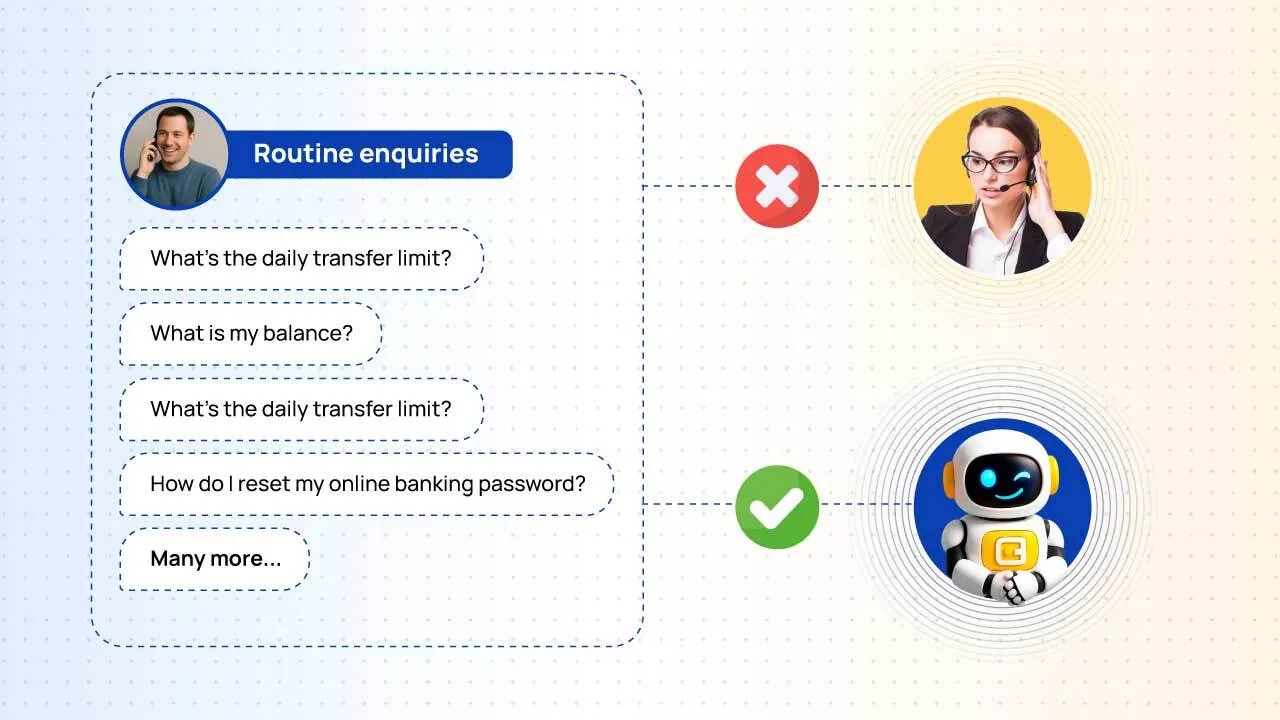
At credit unions with mature deployments, containment rates – calls fully resolved by the AI without agent involvement – can be over 80% of total inbound volume. That’s not call deflection in the traditional sense. Those are complete resolutions.
Step 5: Contextual escalation, not a blind transfer
When a call requires human judgment – a complex dispute, a vulnerable member, a regulatory requirement – the AI escalates based on conversation context, not just request type. It routes to the appropriate skill group, not simply the next available agent. This is the architecture behind what interface.ai calls the Agentic Contact Center – AI and human agents operating as a coordinated system, not parallel tracks.
What the receiving agent inherits: a full conversation transcript, a structured summary of what was discussed and what remains unresolved, the member’s authenticated profile, and any account actions already taken during the AI interaction. The agent doesn’t re-establish context. They continue the conversation.
Next steps
For a broader look at how agentic AI differs from earlier generations of virtual assistant technology, see What is Agentic AI? To see how credit unions have implemented it in practice, explore our on-demand webinars with your peers that have adopted AI.
Kate Rogerson
AI Insights for Credit Union & Community Bank Leaders
Join the monthly newsletter for all the latest industry updates
No spam. Unsubscribe anytime.
You might also like
Your Best Agents are Doing Work Agentic AI Should Do
Your most experienced service reps – the ones who can de-escalate an angry caller, catch a fraud pattern, or talk a customer through a hardship – are spending a big chunk of their…
Kate Rogerson July 7, 2026AI Call Center for Banking
The Real Risk isn’t Generative AI. It’s the Scripted Chatbot Still Running in Your Call Center
There’s a comforting story making the rounds in banking right now: that generative AI is inherently unsafe for member- and customer-facing channels, and that the prudent move is to keep AI in a…
Jack Chawla April 20, 2026Agentic AIAI Insights for Credit Union & Community Bank Leaders
Join the monthly newsletter for all the latest industry updates
No spam. Unsubscribe anytime.