
Radiant Credit Union Scales from $500M to $800M Without Expanding Contact Center
The challenge
Radiant Credit Union was targeting $1 billion in assets with a contact center running on legacy tools and no after-hours coverage. The challenge wasn’t just modernizing – it was absorbing aggressive growth without expanding headcount to match.
The outcome
By implementing interface.ai’s Voice AI and Chat AI, Radiant absorbed 60% asset growth without expanding the contact center team – and avoiding an estimated four additional hires. Voice AI now handles 31,700 calls per month at 67% containment, and Radiant has crossed $1 billion in assets on the same operating platform.
The key results
4 FTE
hires sidestepped with 60% asset growth
67%+
call containment
192K+
after-hours calls handled since Sep 2023
57.9s
average call handling time
Founded in 1953, Radiant Credit Union serves North Central Florida with approximately $800 million in assets across a growing branch footprint. In 2021, under new contact-center leadership, Radiant set a clear goal: grow to a billion-dollar institution without scaling headcount linearly.
High growth, legacy tools,no room to staff up
When Eric Whisler joined Radiant in 2021 as AVP, Contact Center, the credit union was at an inflection point. Growth was accelerating and member expectations were rising, but the contact center’s toolset – a push-button IVR, a basic website chatbot that came with their live chat vendor, and no after-hours support – wasn’t built for where Radiant was headed.
The website chatbot handled only a handful of FAQs before routing members to agents or to email after hours. The phone banking system was approaching end-of life, with a planned e-banking conversion and phone-system migration on the horizon. The IVR compounded the problem – a push-button system requiring members to navigate multiple menu layers before reaching the right department.
With no after-hours self-service and an aggressive expansion underway – new counties, new branches, a merger on the horizon – the contact center faced growing demand it couldn’t meet through hiring alone.
“Push-button IVRs are a thing of the past. I’ve felt that way for years. When I joined Radiant and saw the depth of buttons people had to press to get to different departments, I knew that wasn’t a good member experience, and it wasn’t a foundation we could grow on.”


What Radiant was up against:
- A push-button IVR forcing members through deep menu trees before reaching help
- A self-built website chatbot with almost no real containment capability
- After-hours service limited to voicemail. 30-40 messages waiting every morning
- A planned e-banking conversion and phone-system migration
- A growth target ($500M → $1B in assets) that couldn’t be staffed the traditional way
A collaborative AI partner, deployed across voice and web channels together
Radiant wanted more than a vendor. It wanted a partner that would sit alongside its team – watch the analytics, flag unhandled intents, and actively propose improvements rather than waiting to be asked. After evaluating multiple AI providers and taking Jack Henry’s guidance on trusted integrations into its Symitar core, Radiant selected interface.ai.
Voice AI – the agent Radiant named “Ray” – launched first, followed by Chat AI. The rollout replaced both the basic chatbot from their live chat vendor and the legacy phone banking system at the same time, so members would see a unified, modern self-service experience whether they arrived by browser or by phone.
The collaborative model was the deciding factor.
“What set interface.ai apart was the partnership. They monitor the system, and if they spot a chance to automate something, they recommend it and build it. As they learn better ways to serve members at other institutions, we benefit too. That’s the kind of partner we wanted — not just a tool.””

60% asset growth, one extra hire, zero drop in service
By March 2026, Ray was handling 31,700 calls per month. In that same month, over 7,000 of those calls came in after hours – members calling outside business hours, knowing Ray would answer. Chat AI ran in parallel, handling 2,352 web conversations in March 2026 alone, with 77,000+ total since launching in December 2022. The operational impact was immediate and sustained.
1. Growth without headcount
Radiant Credit Union’s assets grew from roughly $500 million when Eric joined to $800 million today – a 60% increase – without adding to the contact center team. Leadership estimates automation absorbed the workload of roughly four full-time agents, deflecting ~25% of what would otherwise have become hiring pressure.
“We were at about $500 million in assets when I joined. We’re $800 million now, and automation has saved us roughly four headcount – about 25% of what we would have needed. That’s the difference between growing smart and growing by body count.”
2. Industry-leading containment – with context
Radiant Credit Union has maintained strong call containment since launch, historically containing more than 70% of inbound calls without agent involvement. For members, that means faster answers around the clock. For the contact center, it means agents spend their time on interactions that actually need a human – not routine balance checks and transaction history requests. Current containment sits at 67% following a recent feature rollout, with the team actively working to push to 70%+ automation.
3. Genuine 24/7 service – and new demand, not just deflection
Before Ray, members who called after hours got a voicemail box. Morning queues ran 30–40 messages every day; overnight email backlogs were similar. Both have dropped to a handful.
Today, Ray handles 7,000+ after-hours calls per month – and has handled more than 192,000 after-hours calls since going live in September 2023. Average call handling time sits at 57.9 seconds.
But the bigger signal isn’t deflection – it’s expansion. After-hours call volume is up an estimated 30-40% since Ray launched. Members aren’t just routing existing calls differently; they’re calling at hours they never would have before, because they now trust that Ray will help them.
“We had less than 100 calls coming in after hours before voice AI. Now it’s significantly more. Members are calling knowing we’re closed, knowing they’re going to talk to Ray. That tells me they actually want self-service.””
Another proof point that members are taking a liking to Ray is when Ray went down.
“When Ray went down during the Amazon outage, we got more compliments about Ray than we’d ever received. Members were asking, ‘Where’s Ray? Why am I talking to you?’ That was the moment we knew adoption had really taken hold – especially among the members who pushed back hardest at the start.”
4. Chat AI: Web self-service that runs itself
When Radiant Credit Union deployed Chat AI, the goal was simple: give members a web channel that could actually answer questions. It’s now handled 77,000+ conversations since December 2022 – 2,352 in March 2026 alone.
What’s kept it performing is how little effort it takes to maintain. Chat AI automatically scrapes Radiant’s website and documentation to stay current – when rates change, new products launch, or policies update, the AI finds it. The team doesn’t build or update intents manually. Accurate, up-to-date answers are available to members without any manual intervention from the team.
WHAT’S NEXT
From $800M to $1B on the same operating platform
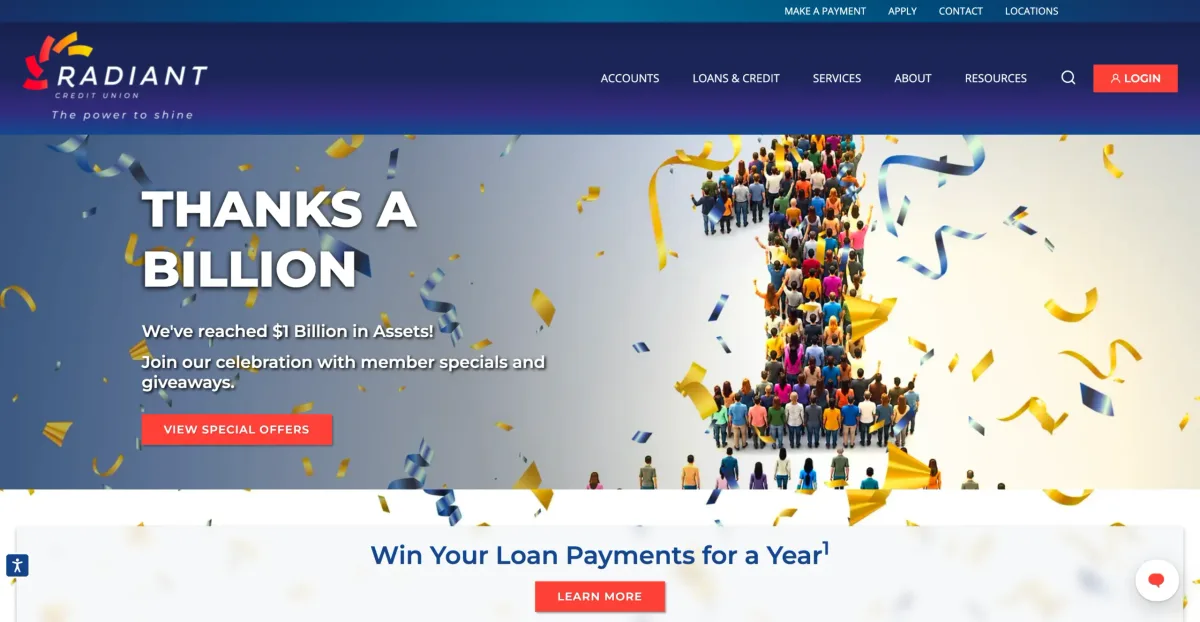
On June 1, 2026, Radiant Credit Union merged membership with First Coast Community Credit Union, pushing combined assets past the billion-dollar mark. First Coast’s members are accustomed to branch heavy, in-person service and have had historically low digital self service adoption.
The merger is where Radiant expects to expand the team – but only slightly. Rather than staffing up to absorb First Coast’s members, the plan is to scale Ray to contain the routine transactional calls and add just a handful of agents for the more complex membership interactions. interface.ai is porting First Coast’s phone number onto the AI agent deployment and working with Radiant on a guided onboarding experience: Ray fields calls from new members, contains what it can, and hands off the rest with context so agents can coach members into the self-service habit.
If all goes to plan, Radiant will cross $1 billion in assets with only a modest addition to the contact-center footprint it runs today.
“I’m excited. I really think interface.ai will help us give our members a different experience – more virtual versus walking into a branch. And if we can get them to adopt the way our own members have, that’s the whole game.”
Growth, without the growing pains
Radiant’s story starts with a simple decision: growth would not be paid for in headcount. Eric Whisler came in from a Fortune 100 background, found a legacy stack that couldn’t scale, and chose a partner that would help him build differently.
Four years later: 60% asset growth, four FTE avoided, genuine 24/7 service, and a contact center about to absorb a merger on the same platform it runs today.
For credit unions facing the same pressures – rising call volume, contact-center attrition, efficiency ratio scrutiny, growth plans the traditional operating model can’t support – Radiant’s results are a clear proof point: you don’t have to choose between scale and service.

- headquarters
- North Central Florida
- founded
- 1953
- membership
- 36,000+
- products
- Voice AI
Download the full customer story in pdf to share with colleagues.
More Case Studies

America’s Credit Union Automates 60% of Member Calls to Deepen Member Experience
Read the case study → Voice AI
Credit Union of America Empowers Frontline Support with Employee AI
Read the case study → Voice AI
We Florida Financial Credit Union Handles Surging Call Volume With Fewer Staff Using Voice AI
Read the case study → Voice AI
Securityplus Federal Credit Union Drives Membership Growth with 84%+ Voice AI Automation
Read the case study → Voice AI
Dupaco Community Credit Union Sets the Standard for Fraud Prevention & Member Service with AI
Read the case study → Chat AI + Voice AI
WEOKIE Federal Credit Union Transforms Member & Agent Experience with Voice AI Upgrade
Read the case study →

Curious about what separates bad bots from good ones?