
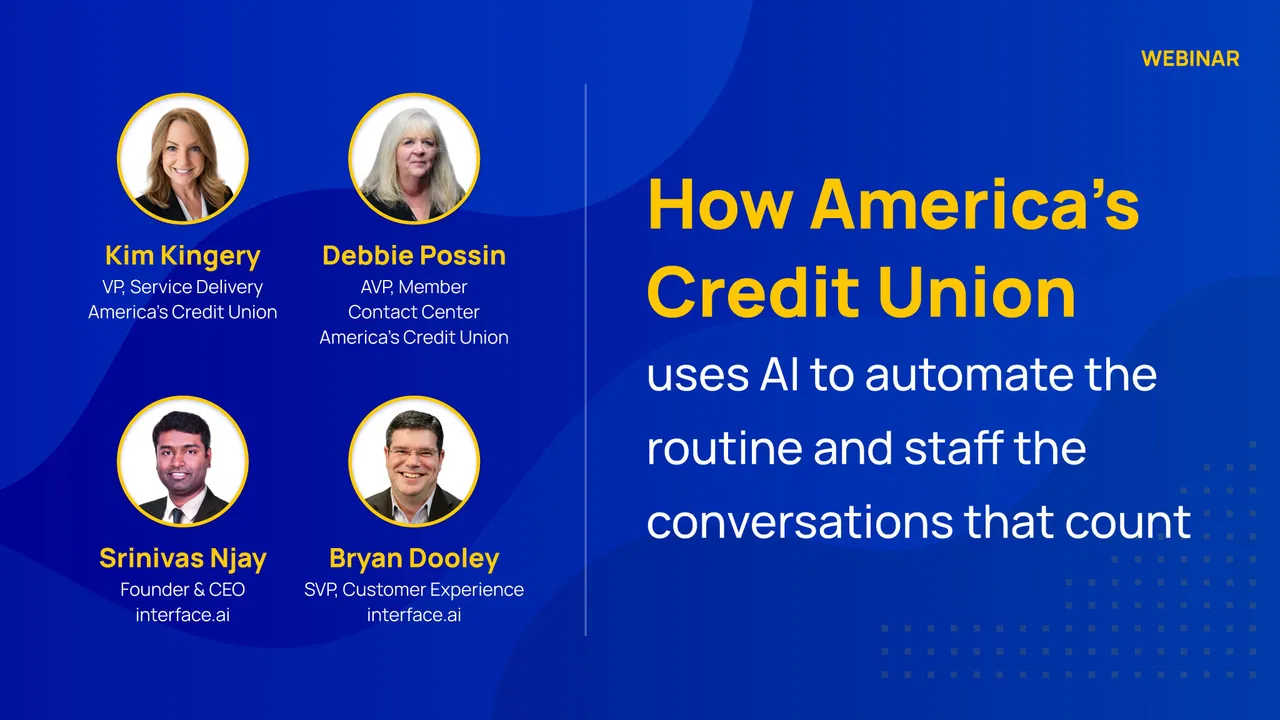
How America's Credit Union uses AI to automate the routine and staff the conversations that count
America’s Credit Union ran calls through a basic IVR with no chatbot and no live chat. ACU deployed interface.ai Voice AI and Chat AI, and five years later it has answered 570K+ calls, automating 60% of them with zero added headcount. Hear how they won over skeptical members, what they freed their team up to do instead, and how much business those 120K+ after-hours calls used to lose to voicemail.
Watch now60%
Call automation
570K+
Calls answered
120K+
After-hours calls
Key Takeaways
The team split the work by design, not default: routine and repeatable goes to AI, anything emotional or high-stakes still stays with a person.
21% of all calls now come after hours, a channel that had zero coverage before - proof members want 24/7 access, not just tolerate it.
A walk-crawl-run rollout (FAQs, then transactions, then voice) lets the team master each step before adding the next, with no headcount cuts along the way.
Speakers

Kim Kingery
VP of Service Delivery, America's Credit Union

Debbie Possin
Contact Center Manager, America's Credit Union

Srinivas Njay
CEO & Co-Founder, interface.ai
Transcript
Hi, everybody. Welcome to the webinar today. Thanks, thanks for joining us. And, also, a special thanks to to our partners at America’s Credit Union, for joining us today and sharing with us how they’re using AI to automate the routine and staff the conversations that count. Just to take you through the agenda for today’s webinar, we’re gonna start. We know there’s several people that that know, Interface quite well as our as our customers. We also have prospects on this call as well.
So we’ll do a little bit of an overview of Interface. We’ll then do demonstrations quickly of three of our different solutions. So our voice solution, our chat solution, as well as sharing a brief overview of our self-service module. And then we’ll get to the main event, which is the conversation with America’s Credit Union, and then we’ll finish off with a little bit of q and a. Just a note, ask your questions as we’re going in the chat. We’ll we’ll gladly answer those, either, during the session or right at the end during our q and a. We’ll also bring up, a number of the questions that you’ve asked, throughout in the chat.
So first, before we get started, wanted to share a poll with you all. The idea here, if you can quickly answer this poll, it’ll give us great context for the conversation today. So a little bit about where you are on your journey with AI, how you’re engaging with your members and your customers. But six quick questions. Hopefully, it won’t take you too long, and then we’ll jump right into right into the content as well.
While you finish doing that, just a brief introduction to this point. I’m gonna introduce, Kim and Debbie. Again, thanks very much for joining. Great partners of of Interface. They’ll do a a a bit deeper introduction as we get later into, into the main event as I as I mentioned earlier. We also are are joined by Sri, who’s our cofounder and CEO, and myself, maybe a new face to some of you. I’m the SVP of customer experience.
And then one of our project managers, Sanket, has graciously agreed to to do the demonstration. So he will also be jumping in as we’re going through the session. But right now, introduction of of interface, and gonna turn it over to Shri to to take us through that.
Wonderful.
You know, thank you, Brian, and everybody joining. This is Sri. I’m the Cofana CEO. Super excited to have an opportunity to talk to you all. And now just a quick introduction to the company and and myself. As you some of you already know, I come from a banking family with my father starting a credit union and scaling up to a couple of billion and, you know, had experience helping him out and and scaling on the technology side of the credit union and also worked previously at Microsoft, part of the AI AI team and everything. You know, started Interface AI in 2015.
Our mission of the company has ever since the been the same for eleven years, which is help every financial institution to scale efficiently and help your members achieve financial well-being. And I’m super excited with how AI is advancing that we could deliver on that mission very aggressively, very fast. And and our vision, what we call autonomous banking, which is having you getting you a AI banker that work alongside your members and employees to drive your member financial goals, also enabling you to efficiently scale. Right? So that’s what we call autonomous banking. We serve over a 100 financial institutions today, processing somewhere between 1.2 to 2,000,000 interactions every single day through our AI platform.
And, I’ve been doing this for eleven years. You know, since, the longest standing, AI, partner out there.
And, you know so we can go to the next slide, Brian. So in order to realize this autonomous banking vision, what we are really building is a digital employee to you. It’s a digital employee that is a perfect collaborator for all of your staff, you know. And this digital employee comes with its own brain, you know, and it is completely comes with only its own guardrails, memory, skills, and tools.
It practically can, you know, take actions on any systems to, you know, execute any task. Right? So, you know you know, as as part of his memory, it would remember, understand everything about your members. As part of his skills, It would have skills to authenticate your member or complete a transaction for your member or onboard a member, help with collection, or help with improving wallet share through upsell, cross sell.
It’ll have tools, which is, you know, basically, tools are the ones that execute the skills, you know, basically take actions through APIs and things like that, which is moving the money, freezing the card, and connectors, which is all your core CRM, you know, debit card, credit cards. It it’ll have the connectors to all of them. And video, there’s no connector. It will be able to navigate, you know, your systems, you know, just like how a staff would do by clicking through it.
It you know, and and we could bring all of these things together to solve a problem, like either it’s a voice AI, chat AI, employee AI. Basically, they are a combination of skills and tools and connectors.
And we build this digital employee with a lot of guardrails, so it it doesn’t make things up. It is fully compliant.
It refuses to tell anything. It’s unsure.
You know, it’s it’s it’s not inventing any interest rates or products.
And it also could be this digital employer could be exposed to your members and employees through any channel. Right? Either voice, chat, employee desktop can speak hundreds of languages, things like that. We think about this digital employee as a perfect collaborator to your staff to 100 x the outcome. Right? We’re all using AI today that has significantly improved our productivity.
But the thing that is lacking with the traditional, you know, chat GPT or cloud kind of systems are they don’t understand our member problems. They don’t understand our systems. They don’t have integration of our system.
This digital employee is designed to solve that.
So that’s kind of, you know, bigger picture in what we’re doing to help drive the vision of autonomous banking.
If you switch to next slide, Brian.
So, you know, this is kind of giving you an idea how these skills, memories, and tools, and connectors come together to work with your existing systems or replace your existing systems. Right? Typically, as a credit union bank, we have too many disjoint systems.
You know, can these systems can’t talk to each other. And the first thing we think about is, oh, you know what? I wanna just, you know, try to figure out a a way to connect to API or replace them and, you know, you know, bring together a a connected system through one vendor. Typically, that’s how we kinda think about it.
Right? So but and then what happens if we try to replace them? We go go through a project of one year without really impacting the business in any way. Right?
It becomes easy for you to work with different systems, but doesn’t directly impact the business in a significant way.
So we decided instead of having you keep switching systems, we build a digital employee that can work across your existing system seamlessly.
Right?
You know, it doesn’t matter. It doesn’t have APIs. It can, you know, it can use, you know, you know, agents to browse through like a human being. So this is to demonstrate how the skills and tools and connectors will come together to either replace your IVR, make a voice AI, or have it work along with your online mobile banking or help the this digital digital employee do collections for you. Right? Or offer, you know, next best offer during a conversation.
So you configure a digital employee, what are skills tools you want, and you can achieve the business goals. Talking about the business goal, go into the next slide.
You know, when you rip and replace systems, they hardly drive your business goal. AI is a true multiplier, not a new CRM or a new CCaaS as a multiplier. Right? Because they’re just another system.
But, you know, this is kind of give you an idea. Like, let’s say, these digital employee coming together, what could accomplish what they can accomplish? Like, you know, this talks about every single number your board cares about, which is cost to serve. Let’s say, you you have a CCaaS, you do you know, one staff can do one call and take five to seven minutes. But if that employee is augmented by a digital employee, then they could be doing 30 calls at a time.
Right? And, you know, growth without headcount is efficient growth is usually very important to us. Again, you know, you can achieve that growth without having to keep linearly scaling your team.
Right? So, hopefully, it gives you an idea how you could configure the digital employee that that works alongside of your of your staff to really drive the multi AI multi multipliers. Right? So that’s the kind of the broad picture on what we are doing at Interface. With that, I’m gonna hand it off to Sanket to show you certain products that are configured within this digital employee platform to create specific products that cater specific business needs, which is voice AI, chat AI, and things like that.
Alright. You guys should be seeing my screen now. Alright. Just to set some context around the demo that we’re gonna do today.
So we’re gonna look at three different parts of our products. Voice AI, which is gonna be your virtual assistant when your members call. It can answer questions, do transactions on their behalf, and automate a lot of the routine things twenty four seven. Like, if they need help in the midnight, it’s gonna be available for them.
The same experience is also delivered through the, chat channel on your website, and different places where, you know, we wanna serve the members with in places where they are comfortable with.
And lastly, we’ll look at Assemble, which is our self serve, tool, which is really built out to empower credit unions and financial institutions really manage and control their AI deployments. Because with AI, when you wanna put it in front of members in a financial domain, it brings a lot of other challenges. And our tools are built to actually address those ahead of time. And just a quick heads up, we are gonna be demoing the, upgraded version of ACU’s, systems. So it’s a fully agentic system now, which they’re gonna go live with very soon. And if you try it right now, the experience might be a little different.
But you can always request your own sandbox, for existing customers. They will automatically get sandboxes to this agent system. And for prospects, you can just scan this QR code and, request for your, sandbox. It will be fully connected to your website so you can really get an experience of how this would perform with, the information that’s on your website and, you know, be able to go through the flows and really experience the product there.
Alright. With that, I am gonna, make a phone call, and we’ll go through a couple of different types of questions and flows. So, we’ll ask some general questions. I’ll ask more deeper questions like follow ups, ask a question, and then just not answer it back out of it.
And then, you know, we’ll also trigger some guardrails and then, look at, you know, making transactions as well. So this is a fully agentic system, meaning it is gonna follow my lead. Right? It’s gonna be very natural.
You guys are already familiar with technologies with Chatty, Witty, and Claude, the way they interact with you. So we have built in all the guardrails around it, everything to make it actually ready to go to production in front of your members.
Hi. I’m America’s Credit Union’s virtual assistant. This call may be recorded for quality assurance purposes.
You can ask for my help if anything.
For example, branch hours, rates, account balances, money transfers, loan due dates, or transaction history. What can I help you with today?
How do I become a member?
Hang on a moment.
Our membership is open to people who live, work, worship, or attend school in the Pacific Northwest.
It’s also open to members and employees of the armed forces and their relatives, members of the Association of the United States Army, and members of the Pacific Northwest Consumer Council.
A minimum deposit of $25 into a savings account is required for membership. To open an account, visit any branch, and a representative will help you get started. What else can I help you with?
What type of checking accounts do you offer?
Bear with me.
We offer Affinity Plus, Affinity Premier, and Affinity free checking account. All of our checking accounts include features like mobile and online banking, online bill pay, and debit card access.
What else can I help you with?
Do you have accounts for teens?
Just a moment.
Still working on that for you.
I don’t have information about accounts specifically for Teams in our record.
What else can I help you with?
What are your interest rates?
Give me just a second.
One moment, please.
Are you interested in our Affinity Premier, Affinity Plus, or Affinity free checking accounts?
I wanna check the balance on my account.
To verify your identity, please provide your member number. It should be five to 10 digits.
It’s 100200.
Thank you. Now please provide your last four digits of Social Security number, debit card, or credit card.
6789.
Thanks. Verified. You have four accounts. Which balance would you like?
Everyday, checking ending in 0123.
Rainy day, fund ending in 0456. Alma and Nad.
Car loan ending in 0789. The travel card ending in 1012.
Travel card?
Your travel card ending with 1012, current balance of $432.10 with $35 due on October 15 and $0 available credit. Do you need a balance on any other account?
No. I would like to check the transaction history of my checking account.
Can I check the transaction history of my checking account?
Working on it. Here are your three most recent transactions for your everyday checking ending 0123. All of these are from 09/24/2026.
Withdrawal of $12.50, coffee collected.
Withdrawal of $5, transfer to rainy day fund. Withdrawal of $5, transfer to rainy day fund. Would you like to hear some more transaction?
No. Should I invest in a CD or S and P 500?
Just a sec.
I’m sorry. I can only help with banking related questions.
Is there something I can assist you with regarding your account?
No. Thank you.
Right. So what you heard during the, call was, you know, being able to ask general knowledge related questions. It will also like, if it’s not able to find information accurately and pinpoint certain things, it’s gonna, not answer those questions instead of, like, making up stuff and, like, trying to satisfy the member’s request. You can also go through transactional experiences and, you know, check your balance, you know, look at the transactional history.
We support a very wide variety of, different types of transactions that we can execute on behalf of the members. And then we also saw I tried to trigger a guardrail where we you know, I’m asking for some financial advice, which we don’t want to do, and that’s what it does. It, you know, avoids giving out any type of financial advice. There are different types of guardrails we have in the system.
And, you know, if you try to brute force it, it’ll just back off, either transfer you to the member or ask you to call back.
So I’m gonna do a second call where we’re gonna look at a, a device biometrics flow, which is specially built to actually, reduce the overall time that it takes to authenticate the members when they actually wanna go through certain transactions. That is the number one friction point that we see, that, you know, members have when interacting with an AI system that, you know, if there’s an issue with an authentication, they’re gonna abandon the call.
So as part of that, like, we Before you, go ahead with the demo, Sanket, I just wanna add while you set it up, probably start the demo.
You know, one of the things that, I wanted to call out is all the responses that were coming was completely agentic. There was nothing was scripted. It was looking up up the information from the website in real time of documents that is fed by ACU.
You know? And and so it’s pretty much kind of, you know, real time completely unscripted. But at the same time, it has a guardrails to not go beyond the knowledge they’ve already fed. Right?
So we’ll be showing on the back end how it works, including transactions that are agentic. Right? Like which is extremely hard to do. You know, transaction needs to be a 100% deterministic.
But this, you know, agentic systems usually are not. So you we have to engineer for several years to make it 100% accurate.
So you don’t you know, sometimes you are choosing systems that guarantee 100% accuracy and have you do a lot of manual work to achieve that. So, basically, you lose the benefit of agentic systems.
In in in in return, you promise 100% accuracy.
We felt, you know, neither of those should be a compromise. Either 100% accuracy should not be a compromise or maintaining it and not manually training as if it’s not an AI system is is is not an option. Right? So we wanted to build a system that can do both.
Right? It’s easy to maintain, and it’s always a 100% accurate. So that’s that’s kind of the unique thing about us. We were able to kind of do enough r and d to achieve both on our side.
Right? So what Sanket is gonna show you is the next advanced level in in the same call but a different conversation.
You’ll be able to see for a high risk transaction, the AI will be able to do three factor authentication in ten seconds or less than that. Right? So, know, using face ID, call ready for m six, and sending text message to the registered number and all of that. And also, AI is gonna upsell cross sell during the conversation to drive these interactions, routine interactions and transactions to revenue generating interactions. So, Sankit, we should should go ahead.
Yeah.
Alright. So I’m gonna call a different line. This is where my device is registered for the device biometrics, so we’ll go through those close now.
Hello. I am Ken, America’s Credit Union virtual assistant. Please note that this call may be recorded for quality assurance and training purposes. Your privacy is important to us.
You can ask for my help with anything. For example, you can say account balance, deposit status, transfer funds, transaction history, or loan payment. Can I help you with today?
I would like to check my balance.
Let me get that information. To verify your identity, would you like to use device biometrics?
Yes.
Okay. One moment. I have sent you the text with the secure link to authenticate.
Please provide consent to continue with device biometrics login.
Thanks. You’re authenticated. Let’s continue.
You’ve got a business checking account ending with 7890 showing 1000 available in current balance. Your vacation savings account ending with 0987 has $2,000 available in current. The car loan account ending with 0988 has a current balance of $1,000 with a loan payment of $1,000 due on September 4.
Your credit card ending with 5678 has a current balance of $15,000 with $500 due on September 4.
Would you like to check the balance of any specific account?
No. No. I’m good.
Based on your balances, you may qualify for a higher yield or premium account option that reduces fees and increases earnings. With your combined balances, you could qualify for a premium checking account that waives monthly fees, earns higher interest, and includes perks like free wire transfers. Would you like to hear about the premium account options available to you?
Yes, please.
Alright. One moment.
Great. Our premium checking includes higher interest, waived monthly fees, free wire transfers, and overdraft protection. Since you already bank with us, the upgrade is quick.
Would you like me to send you a text with more details?
Yes, please. Yes. Can you please send me the text?
Let me look into that for you. You should have the information now. Is there anything else I can support you with?
No. Thank you.
So, what you guys just saw was, you know, using device biometrics to go through the entire authentication flow pretty quickly. Once the device is registered, instead of asking members for sensitive information on the call, we can use Face ID and things that they are usually familiar with and, set their devices up for, like, quick authentication. And then after the call, it was it recognized that I’m eligible because of higher balance in my account to have a a high yield, savings account. So, it asked me about it when I showed interest, and it sent me more information about it on the text.
And you have control over actually creating these offers, maintaining them, all of that through the assemble UI that we have, which I’ll, go in there shortly.
Alright. So for the next part of the demo, I am gonna go through our chat AI product, which is, again, fully agent tech powered by the same knowledge base, the same knowledge system with all the tools and capabilities of making transactions, being able to answer questions from your knowledge base, etcetera.
So let me start by asking you the same question we had asked on the phone call. How do I become a member?
And what’s gonna happen is, again, this is gonna go ahead and, like, span out, look at all the ingested information we have, you know, figure out what the right answer is, and then come up with it, format it, and present it to you. So what you’re seeing here is now that, you know, we have a similar response, but it’s, again, formatted more and tailored more towards the chat interface that we have.
So I can go ahead, and, I’ll just probably highlight a few things. So, again, just to show that it’s the same kind of a response. You know, if you live and work in the Pacific Northwest, you are eligible.
You know, if you’re in the United States Army Association, you’re eligible, and then, you know, you’re gonna require a $25, deposit into a savings account.
So I’m gonna go ahead and ask a few more questions that, typically, you know, we see people asking, on the chat interface. So do you offer online banking?
Alright. So, again, in this case, same process, it’s gonna look at what you’re asking, understand the context. Even if you switch topics multiple times in flow, it’s gonna be able to handle that as well. So when I asked about online banking, it’s focusing its response. Like, yes. We do offer it, and you have, like you know, there are, these are the different features for it. There’s no monthly maintenance fee for online banking, etcetera.
I’m gonna ask it about, like, you know, what are the features. So it’s so it’s gonna actually understand that, you know, I’m still in the context of online banking and then just be able to, like, narrow down further and probably give a more elaborate response in this case.
So, here, what you’re now seeing is that it is actually, like, giving a little more detailed response with all the things that you can do. We can do it. You can control your finances from anywhere, check account balances, transactions, bill pays, and lots of other things that you can do.
You know, there are features for, like, controlling your, credit cards, getting e statements, all of that. You can apply for loans, etcetera, use Applebee. And you’ll also notice that it is also, like, going to give me citations, which is very important, because we wanna make sure that we are supporting all the information that AI is giving with solid proof that it is coming from your knowledge base and your website. So it’s always gonna come up with the right relevant citations and then provide those links for you to actually explore more, verify the information, and so on. So in this case, it is actually correctly pulling it from the, online mobile banking web page, over here. So I’m gonna ask a few more, questions that, you know, continue on the topic and, kind of go deeper into it. So do you offer Zelle?
Right. And in this response, particularly what he ended is, it’s not just giving you that, yes, I offer this. We do offer result. Right?
But it is also saying that it is directly available in our mobile banking app at, you know, basically, it retains the context that I was talking about online banking and mobile banking. So when it offers the next answer, it is actually saying, yes. We do have sell, and you can use it directly from this, online banking. Now I can also ask it a follow-up question, which is just a redundant question, and it’s gonna just follow my lead and actually go along with it.
So if I ask it, is it part of online banking?
I had already asked this question about online banking in general. I asked about Zelle. It answered that question. Now I’m just trying to ask it the same question again.
So, in this case, like, I just asked, is it part of online banking? I did not ask, is Zelle part of online banking? And what it did is it understood the overall context of the call, and then it’s giving me the response that, yes, you can use Zelle inside our online banking. So it’s not scripted anymore.
It doesn’t have to actually, like, rely on exact specific flows and sequences of messages that people have to give. And this is, again, all powered by a same central knowledge piece, that you’re gonna manage, in one loop. Okay. So I’m gonna go ahead and show a couple of transactions here and probably try to show you also the money movement side.
So, same capabilities you can get through this chat channel as well.
Now if you notice the difference when we made a phone call and asked about balances, it did not go ahead with the entire entire list of, like, balances. Right? It it asked me which account do you want to, look at and then followed up with the balance for that. But here, because this interface is has more real estate in it, it is actually, like, just giving me the entire list of accounts that I have along with the balances, like, the, available balances, current balances, and so on. And then we also have, like, smartly provisioned, different options that users can directly select, so it keeps the conversation going. So let’s say I wanna, look at the transactions.
So it’s gonna filter down the, accounts to you know, which we can support looking at transactions at, based on the core capabilities that are there. So now it’s asking me which particular account I want to look at. So it smartly understands that when it has has to actually disambiguate and when it can actually keep the entire information out.
So I’m gonna try and, start to move money here. So it’s gonna then trigger a step up authentication. So when we started with the check balance and the regular flows, because these are low risk transactions and are not moving money. It’s just asking me for member ID and last four digits of my SSN or credit card. Again, these are fully configurable, based on the needs of the credit union, and you can control what’s used what factors are used for authenticating the member.
So I wanna transfer funds.
Now what’s gonna happen is because this is a higher risk transaction, it’s gonna ask me a few more follow-up questions such as, you know, do you wanna move it internally or externally? Again, you can have the, option to choose what do you support through these AI channels, what type of money movement is supported, what are the limits on the amounts, and so on.
And now it’s gonna actually also step up the authentication, and it’s gonna ask me for a one time passcode. Again, this is fully configurable. You can choose emails. You can have security questions around it.
So I’m gonna choose an account, a phone number. Whatever is on file, it’s gonna smartly understand what’s a landline phone number where you can get an SMS. So it’s gonna remove those things and just smartly select which accounts can be supported, and it’s gonna ask me to, it is gonna send me an OTP and then ask me for it here. Alright.
So now that we have entered and we are authenticated, so now it’s actually, like, just asking me which internal accounts do you want to move money from. So let’s say if I wanna move money from a checking account, now it picked up that if yours there are two accounts, you have to move money from one to the other. It’s gonna automatically select what the destination account here is gonna be. So let me do so it’s gonna just wait and ask for my confirmation again.
And if I see yes. Confirm. So now it’s, you know, actually gonna do the transaction. Obviously, this is connected to our core, so it’s gonna be a dummy transaction that we do.
But we connect with a lot of cores, probably, like, most of the course that are there in the industry and support all of these transactions across the board.
Alright. So that was the demo for the chat AI product.
I am gonna now go into Assemble, which is our self serve tool where you can, you know, manage AI. You know? And then we have special capabilities that actually allow credit unions to be very efficient at doing it. Because when you introduce AI and start using agent tech systems, it brings a lot of challenges. And, we’ll talk about those, and we’ll show you specifically how we actually address them. So what you’re seeing here on the screen is our self-service portal.
And on the left side, you’ll see a few options for you. There is conversations, test studio, knowledge management, and so on, which we’ll kind of focus on.
The first thing that I wanna highlight is the voice, conversations. So you have insights into all the conversations that are happening in the system. And one thing that we especially pay attention to is, actually measuring the AI output on how the members actually experience the call and what their, perception is gonna be. So instead of simply measuring automation rates or transfer rates and containment rates, which don’t actually tell you the full story of, like, how members experience something, we actually go a level deeper and wanna make sure that members are having an amazing experience, top notch that they can get in the industry.
So we measure the calls on experiences. So what you’re seeing here on the center panel is the exact transcript of how a particular call went. On on the left panel, you’re gonna see AI driven summaries. And here, we actually break down the call into different goals that a member had.
Why did they call about, and did we actually satisfy each and every single one of the questions that they had? So here, it was about memberships and then checking accounts, interest rates, routing numbers, all of that.
So Sanket, if I could jump in real quick. You know, we we all, like to do surveys. Right? Like, we’d like to ask our members or employees how things went, but surveys are so skewed. Right? Like, only if people who had really negative experience would reply or people really positive experience would reply.
So but it’s very limited information. Right? So but if you’re deploying AI that is intelligent, then a that intelligent AI should already know how it did without asking somebody.
Right? So that’s that’s really the concept concept of experience score. Right? So it is self evaluating itself and telling how it went across every single call. And it is self evaluating itself across three parameters, which is did the member or employee achieve the goal? Why whatever the reason they started the conversation, did they achieve the goal?
And did they achieve that goal efficiently? As in did they had to go in the loops to achieve their goal? And know we all been in that frustration. Right? So and the third is, what was the sentiment while achieving the goal? Did they use some swear words during the conversation?
You know, things like that. So we are taking all these signals and measuring how it went. Right? So that’s what experience score means.
Right? Which is this kind of directly translates to us as a credit union industry because we believe deeply in ensuring a personal touch. Right? Like, we don’t want to automate for the sake of automation.
You know, the reason that people like to bank with us is of that personal touch and personalization and everything. Right? So so we want AI to be looking at all these signals and get out of the way if any of that is dropping and get a human involved. Right?
So this is the AI that understands the balance of automation and efficiency and sentiment altogether just like you want anyone reflecting, you know, creating in its way of serving. Right? So that’s like that’s that’s how how much thought gone into it. And then that way you have go back previous screen, the admin screen.
So if you look at the experience score, know, you said, like, overall sentiment neutral. Right? And across every call, you can see the experience score. So you can now practically have a survey for a 100% of your conversation.
Right? Not just a subset. Right? And and it that it is also using those signals to get out of the way to make sure the members are having great experience.
So it’s not a score that comes after the fact. It is a real time score that is being evaluated during the call. If that experience score during the call itself drops below a threshold, it moves the call or a chat or an employee conversation automatically escalates it to a staff. Right?
So that’s kind of how Delegately it’s designed to ensure it meets how we serve as industry.
A couple of things I wanna show real quick. We’re running out of time. And, you know, we wanna make sure we are able to get most of the time for Kim and Debbie to hear their experience.
You know, agentic systems are have infinite canvas. Right? Because if you’re pointing it to a document, you’re pointing it to a website, and you or your integrations or connectors, and you expect AI to learn and answer a million questions. Right?
Because imagine the kinds of questions your website can all answer. There’s infinite number of them. So it’s almost impossible to test them. Right?
Because in the old school systems, you could actually have a scripted responses, which even today, many do that. And then you have a finite canvas to test them. But if you have a infinite canvas with agentic systems, those two AI systems, it’s almost impossible to test them. Right?
So that’s why we created AI itself to test and give you the score transparently. So if you go to test studio, we have designed a whole system around automatic testing. So you can literally come here and see how it ran, you did the authentication pass, disambiguation, planning, routing, balance transfer behavior. You you could have one stop shop to see the entire testing.
And one of the unique things about this is this is not a static test case. Right? Every time your members are having interaction, employees are having interaction, the test case are automatically growing based on what your members are asking or your employees are asking. Right?
So so you can even come here and see the golden dataset. Right? Let’s say all the test cases, it keeps adding on its own and improving the coverage of the test cases based on how members are using. Again, because even how members use is not a finite canvas.
Right? They could be asking different kinds of question because of its true AI capability. So the test cases automatically grow and shows you what are all active and things like that too. Right?
So and one last thing I wanna show you before we hand it off to Brian to go go chat with Debbie and Kim is, you know, the biggest challenge with deploying AI is knowledge cleanup. Right? We’ve all been there. We’ve all been told AI can be as good as the knowledge you feed or integrations you feed.
Great. But, you know, if you want to launch AI and then you had to go through this cleanup project that you you have to take another six months to do a cleanup project before you do it, then it makes no sense. You keep deferring the value you can get from AI. AI needs to be done yesterday, not tomorrow with the kind of impact it can bring and the way it changes the organization.
And and you don’t want definitely go on a cleanup project without knowing where to clean up, what to clean up. So we designed an a system where you will have a single source of clean knowledge across your enterprise in in this AI. So we come to the knowledge hub. So let’s go to sources, Sanket, first.
So you can feed all the knowledge, SharePoint, URLs, local documents, or even network drives. It can feed everything into AI. It’ll take time to process it, and there’s some magic gonna happen, which is it’s gonna figure out all the things you need to clean up and show you that in one place. So if you go to the governance section, it shows you all the conflicts. So let’s open one of the conflicts.
It seems like there is a, you know, conflict related to the rate APY, you know, for a deposit account performance saver is 1% in one of the sources and 0.25% in other sources. Right? Like so you can go through this wizard, clean up entire enterprise knowledge, Right?
And have this to be one source of clean knowledge that AI helped you to clean up without you having to spend months together. So and now AI uses those knowledge and kind of serves all of your members. Right? So that’s kind some of of the things, you know, we built there to make your agentic experiences better so you’re not compromising agentic experiences or dealing with the challenges the agent experience bring.
Rather, build a system that proactively tackles with those challenges and makes it a more positive outcome overall. Right? So there’s a lot more in in this, you know, if you wanna set up holiday calendars and everything. You know, two days before the holiday, how AI should remind members about it.
Or two days after your, migration, what AI should tell, oh, we’re we’re, you know, we’re catching up on the call volume. Please bear with us. Whatever. So it has ability to configure all of that in very thorough detail and things like that.
So, you know, we we you know, as Sanket showed in the beginning, the you know, we happy to give you access to your own sandbox so you can actually, you know, go deeper and experience all of this.
You know, feel free to reach out reach out to us, you know, just sales@interface.ai or scan this QR code. We look forward to giving you a sandbox to play with it.
With that, I wanna hand it back to Brian.
Brian, back to you.
That’s it there.
Sorry. Thanks. Thanks, Sanket. Thanks, Sri, for sharing that. So as promised and as Sri pointed out, wanna make sure that Kim and Debbie, who’ve been great partners of of Interface along with the rest of the America’s Credit Union team, Appreciate them being on again, and would love for for each of you. Maybe we’ll start with Kim, a brief introduction of yourself, and and then Debbie, and a little bit about America’s Credit Union that you wanna share with with the attendees of the webinar today.
Hi. I’m Kim Kingery from America’s Credit Union, VP of service delivery.
If we have a lot of credit union people out there, you know that probably entails well, we’re seeing quite a few different departments, but it’s mainly it’s the back office and digital and and our member contact center. And we love our partnership with Interface. We’ve been gosh.
I think we started talking with you back in during the pandemic is when it all started.
Debbie, you wanna introduce yourself?
I am Debbie Pozin, and I’m the AVP over the call center here at America’s Credit Union. I oversee all call center agents. I have an MSR team, and I’m also over the ITMs.
Excellent. Well, thanks again, both of you. I know we have a a few topics that we wanna get through, so we’ll we’ll move through those. And, again, appreciate you sharing, your experiences, especially as you pointed out. Kim, I think we started working on 2021. The conversation started in 2020. So you’ve been been working with us for for quite a time.
What made ACU decide to adopt AI?
And what were some of the the things you were hoping to achieve when you engaged in the partnership with with Interface?
Well, if we go back, we had just a basic IVR system. Just members calling in basic. Calling in, talking to Debbie’s Debbie’s group. And we didn’t have we didn’t have a live chat.
We in which we still don’t, but we are looking into. But, look, what we wanted is the member to well well, what should I say? To make the member experience better and to be accessible twenty four seven, which later on in this, I will share some numbers for our after hour calls. And it’s actually, did exactly what we wanted it to do.
You know? And to go what we did during during the pandemic, we saw the need with all the calls and the increase in our online activity.
So that that’s what made us start talking to Interface, and then Interface, you know, being who they are and working with so many credit unions was just a perfect fit.
Excellent. Debbie, did you wanna add anything?
Or Yeah.
There was some there was some things that I’d like to achieve a little bit live with it too. I know we all have those members that call in every single day for their balance, and, you know, that that takes time away from the reps as well. And and I have to say Interface really has has taken over that. We’ve seen my reps can spend a lot more time with the members that we really have to dig deep with.
And the 24247, they can call in and do transactions or by our website as well. So it’s it’s really helped our team a lot.
Excellent. Thanks for thanks for sharing that.
I think not dissimilar to to many of our customers, and a lot of a lot of our prospects think the same way about kind of a crawl, walk, run approach or a a phased approach to to deploying AI. I know you started with with chat, then went to voice, then expanded, chat further. Can you can you walk us through that approach and and maybe what you learned through that?
You’re right. We did it was a a crawl, walk, run. We started with the smart discovery launch in September 2021 and then went and that that’s just mainly if any smart discovery is when they’re just asking the basic questions.
And then we went to the smart transactions and then what’s called smart conversion and the a I AIPB, which call center.
And, just just did we just did it. Like like you said, we went very slow.
We made sure that our team understood what we were doing and the steps that we were taking.
And I think that’s just doing that, just I can’t say it enough. Start slow and take your time.
Make sure you’re doing it right because it’s new to your members.
And Members don’t like drastic change. Yeah. So rolling it out one step at a time was a lot easier on on us and, think, our membership too.
Yeah.
And you wanna start like, we did when when we started with the smart discovery, you wanna start with the lowest risk and get your You know, get your feet wet and then just keep adding to it.
And, you know, we’re constantly doing that. I mean, with each version that we’re rolling out, it’s something new. They roll out to our members.
Yep.
Great. That’s great. Shree, I know, as I mentioned, a a lot of our customers, take a similar approach when they think about their rollout. Do you have thoughts on, you know, how you would recommend, FI’s approach, the rollout, and and member adoption and and driving member adoption both at launch and and post launch?
No. Absolutely.
AI has come a long way, and we keep working with ACU to keep deploying better and better AI. Right? I think things have changed.
In terms of the rollout, you know, it it really depends on the kind of the comfort of the financial institution. Right? Like, you you know, if if you feel your members, it it also depends on the kinds of members you’re serving. Right?
Like, you know, if if if you have in the past, one of the kind of the thumb rule you could use is how is your other member facing technology adoption and changes that members have, you know, members have pursued. Right? Are they faster to adopt some of these changes or they’re a little slower? They need a little more hand holding.
You know, those those are kind of the parameters determine what makes sense for each financial institution.
You you know, the the you know, you kind of think about a framework that way.
And, you know, there is, like, there’s one of the things we did as part of the platform is to make it extremely flexible in the journey you wanna choose. I’ll give an example. There is even a crawl before crawl, right, which is, you know, you could literally launch it for your after hours, right, and see how it goes, and then make roll it up to twenty four seven.
So extremely flexible. We when you talk to us, we can also guide you based on your kind of members and how they pursue previous technology launches and and what is your risk appetite and things like that.
Excellent. Thanks for sharing that.
So, Debbie, you had you had mentioned just before about that that member experience. So how have you at ACU balanced leveraging AI through interface with the human touch that’s that’s necessary when trying to provide that that great member overall member experience to to your members?
I think the goal to AI is to create more time for our human interaction. So AI can take care of the quick, easy transactions where my agents can really focus on the time consuming deep conversations with our members and and establishing that relationship. I think AI needs to take care of the task, and my agents take care of the relationship that they build with the members. So it it’s a good balance now. So it it works great.
Excellent. Kim, anything to add?
Or I think Debbie Debbie, covered it.
It’s Yeah.
And, literally, it’s a seamless handoff.
When when our member, you know, gets the first part of their question answered from our Ken bot and they they need to talk to one of the agents, the agents are not they do not need to ask the questions over and repeat and have the member repeat themselves. They can see exactly what was taking place during the conversation with the Ken bot. So it’s very seamless. Our members are really liking it now. I’ll say now because they had to get used to it. But but now we we and we get positive results and positive feedback. Yeah.
Yeah. It’s also, like, how the rest of the world around them is also getting them used to AI too. Right? Like, you know, if they call Walgreens, CVS Pharmacy, amazon.com, you know, u UPS, they’re all using AI too. So, you know, I I think collectively, the the whole industry as it adopts AI, the members are gonna be more open and friendly with it, right, so to using it.
I think, like, I completely kind of, you know, agree with how Debbie is saying most of the financial industry are approaching AI and human support in a similar I mean, AI and human touch balance in a similar way.
You know, it AI could either automate or argument.
Right?
When it automates, you know, there’s a staff that the staff gets the most important time back to them. When I think about like, come from credit union background too, when I think about the people helping people.
Right? So that doesn’t mean people helping people with balance inquiries of fund transfers or, like, you know, routing numbers. Right? People helping people for me means, you know, truly helping people on a difficult problem, a financial journey.
Right? So that requires human touch. Right? But in when in when humans are involved doing that, the AI could still augment them, but they are the front facing, which is front facing with the members.
Right? So there’s more there’s both options of AI doing automation, freeing up the staff, and then also assisting the staff, you know, so that they can continue to focus on relationship, you know, empathy and things like that. So they are not bogged down with, you know, you know, manual manual task. Right?
Like, if if a member is in the branch or a call center talking to you, you don’t wanna be constantly looking at your laptop typing or clicking the buttons. You know, with AI assisting helps you also help you know, it applies to stay focused, actually high productivity, and things like that. So that’s the best kind of balance, I would say, between the AI and human touch.
Right. Thanks, everybody.
So, obviously, we talked about the journey and and the the journey that that you’ve gone on with with AI at at ACU, the member experience as well.
But, ultimately, you know, a lot of it comes down to what has the impact been on your operations. And I know we’re gonna talk a little bit about the after hours experience in particular, but just in general, what has the impact been for for ACU and and your partnership with Interface?
Well, like you’re showing right here, 60% of those calls are fully automated calls now. And you can see the numbers below.
So it really helps Debbie’s team focus on, like like we were saying earlier, the the members’ needs and better the harder questions and, you know, get building those relationships with the members, not the basic routing numbers and things like that that can just be done by the Kenbot. And so that’s really helped build the relationship between our call center agents and our membership.
Great. Thanks for sharing that.
Kim, you had also shared, earlier, teed up this this next question about after hours.
But how has integrate AI been integrated with your after hour setup, and what has that shown you?
Oh my gosh. That has been so fantastic.
We and I’m just I’m bringing up the most current hour, numbers just so I have them in front of me here.
Our total, after hours calls have been was a 118,000 calls. Those are calls that we would have missed. And a lot of times that they wouldn’t have called back.
So we’re so grateful. I mean, that just that blows my mind usually. Every time every month every single month when I have to report this number, it blows my mind. So, like you said, 20% of all of our calls come in after hours. That’s a lot. Wow. And those members are being helped.
Nice. Excellent. Debbie, thoughts from, I guess, after hours?
I don’t know if it impacted your teams at all for for the live agents with not having that Monday morning crunch or anything like that.
It does. It helps with the Monday morning crunch. Not saying that we still don’t have the Monday morning crunch.
But Right.
No. It does. And it it also, I think, you know, helps our members as well.
We’re busy now, and, unfortunately, we can be available for them, you know, twenty four seven.
You know, even if it’s a loan application, you know, we’ve we’ve got after hours help for that now too. And so, yeah, I think I think it’s helped tremendously for the credit union as a whole.
Great. Thank you. And how did the members respond at first? And and, you know, obviously, working with with our other FI partners, there is an evolution for those members, but it would be great for you to share kinda that that initial experience as well as how that’s evolved over time.
Yeah.
Initial was it was a little rough, especially for our older members because they they like to they like that human touch.
But once we talk to our members about it and explain what it can do and you have access, you know, all the time. You don’t have to wait in our phone queue for ten or fifteen minutes to get your balance.
They adapted to it. And and now I I don’t get any complaints about Ken. I haven’t had one in in a long time.
You know, we get that. Can you walk me through it? Or, you know, what button do I press? Or and it’s like, you just talk to him just like you’re talking to me.
So, yeah, it’s it it was it was challenging in the beginning, but it was a short term challenge.
They got used to it, and then, you know, it it just rolled with them. So but I think any any product or service that you, you know, you roll out, you’re always gonna have those few that fight you with it. But Yeah.
But it’s been good.
Sounds like you’ve had your your member service team engaging with the members about it as well and saying You know, this is the Yeah. Driven a lot of that that adoption for for your members and comfort from your members hearing that from your team.
Yeah. Yeah. I I try to have them roll it as a positive Because it is. It’s a positive to us where we can we can spend more of our time with the members that really, really need us.
So Right.
Great. Sri, what’s what’s your take on setting and and member expectations in general and then setting those expectations with your members as an FI?
Yeah. I I think it’s definitely, the newer AI are extremely capable in terms of almost, you know, indistinguishable from human empathetic wise sometimes and how knowledgeable they can be.
You know, just but sometimes people don’t want to clearly set expectation that it’s an AI, and I think that’s a wrong move. Even though it is getting better every day and and very capable and human sounding like, it’s important to let your members know either talking to AI. Right? So yeah.
At the beginning and things like that. And welcome to ACU with, you know, can digital assistant. That’s an important part of it. And then I think the big part of driving adoption is AI is a learning software.
Right? It’s it’s gonna keep learning the the the way people are asking questions, and it is learning the the things it can do. The number of skills and tools, it’s it’s it’s a growing thing, which means it can it can do things that it didn’t do three months back or six months back.
But sometimes with member call you call the AI, and then they realized for the question they asked, it went to a staff.
Even though AI learned six months later, if you don’t do education to your members and get them to a place that it’s a learning AI, then they would often choose to talk to a staff next time too. Right? Like, it’s, you know, it’s ultimately, it comes down to making sure your members understand it’s a learning system because nothing like this exists in the past. Right?
Like, your online banking was not a learning system. Your, you you know, your text messaging solution, not a learning system. So, you know, I think that’s the important mindset change you need to drive with the members. The moment you nail that, it’s gonna be a big success.
Right? So, you know, that requires, as Debbie clearly said, like, you know, it’s it’s the initial few months is the kind of of the key. Getting them to that, you know, understanding and getting them to be comfortable to using the system. Many times, they also have concern.
Hey. Can I give SSN to my this AI? Right? Like, can I authenticate? So telling them this is just like any other banking system.
It’s safe to give those information, and and then getting them to understand the learning system, they should come back, try even though last time it didn’t answer and things like that is the key to driving and setting member expectation driving an option.
Right.
So two two more questions that that we’re gonna cover, but just gonna pause here for a second just to remind everybody, keep asking those questions in the q and a, seeing a few good ones coming in. Looking forward to to answering those when we get to to the end of the session. But back to back to the current question, obviously, been a partner of of interfaces for for quite some time. What made it the the right fit when you chose us back in in 2021, and what makes us the right partner for you now as well?
Well, back in 2021, you know, we we went out and we talked to several providers, and we did our due diligence. And when talking to Saree and everybody, Interface was built for credit unions and small banks, and that that was really intriguing to us. And and what you guys also had the out of box integration. So, you know, we were able to, you know, grab the smart conversions and just the out of box and really just build on that. And that was that’s what helped us make our decision.
Awesome. What what about what about today?
Well, now we’re we’re a partner with with you. We’re not we’re not just a credit union and vendor type of thing. We’re a partner, and, we work very closely.
We I just I enjoy our partnership because you keep us informed constantly. You’re constantly building what whatever’s out there. You’re you’re looking at what’s new, what could we do better for for the credit union, and I really appreciate that.
Great. Yeah. No. We we feel the same way, and I I love hearing that. You know, a partner, not a vendor.
That’s that’s the ideal outcome for these relationships, and and we appreciate your partnership as well.
Sri, I I don’t know if you have any anything else to add to that as far as why you think FIs choose Interface as their as their AI partner. I know the ACU team has shared quite a few of the reasons that that we know are out there, but I don’t know if you had any other context to to share with everyone.
What came on the reset is a mic drop moment. Agree.
I agree. Can be added.
I I think, like, you know, I I I really value they say that, like, because the the real meaning of partner is that we are anticipating your needs ahead of time and specialize in a technology, use that technology to solve those needs much ahead of the time before it is before you the the before our customers need it. Right? So I I think that’s when you become a partner. Right? Like so and and I think we strive for it. We could keep doing better.
You know, as as a founder of a company, you can never be happy what you do, but, you know, you always want to do more. And and I think we we work I I I would say we work the hardest at it. So I’m I’m I’m happy that, Darwin, Kimi, recognize that. Thank you.
Alright. Well, last last formal question, then we’ll go to the the q and a from from the audience. But just thought this would be a good way to to to end things, especially with you being, you know, a long term partner of ours. If you were advising an FI that hasn’t yet adopted AI, what what would you share with them?
I’d say do it. Do it. But do it slowly. Yep. And, make sure you’re communicating every step of the way with not only your membership, but with your teams, with your staff. Get their buy in first.
And reminding your team that you’re not bringing this isn’t here to cut staff.
It’s here to enhance it Yep. And enhance the relationship.
So a lot of times, they think, you know, a chatbot, AI, they are coming in, and we’re gonna to take the place of your staff. It’s not.
And I pick a partner who knows credit unions. That’s what we did, and we’re very happy.
So just a a follow on. I’m gonna break protocol here a little bit.
But one of the questions was literally what you were just talking about that I I wanted to make sure that we cut off from the audience that asked, have you reduced staffing level levels? But, also, just followed on how you handled that. Like, what what have you done? If you can just, I think, for the audience, what what has have you done and how have you handled that within your contact center to to to take on those deeper engaging conversations with your members? Is there anything additional to add there for the whoever the audience member was that asked? I don’t see who asked.
I’ve actually increased steps since we we rolled out Interface. I was also able to take on some different areas as well. I mean, I have three MSRs that do all of our online and loan applications now. I we had the chance to take on the ITMs as well. So not only I mean, Interface has helped with that to build our team a stronger team. And and I do have more agents now than I did prior to launching Interface.
It enabled us to grow with the times Yep. With the environment. Yep. That’s exactly what the contact center is not just a call center any longer.
We are we’re there for relationships. We’re you know? So we were able to bring in additional functions that will help with the relationship. So it was a partner that and that’s all it was. It was a partnership. It wasn’t to take place of anything else.
Yep.
Great. Well, thanks. I I did cut off Sri’s final part of the question, but I I think I think his answer is probably gonna be the same as what what you said, which is just do it. But I’ll I’ll see if Sri wants to add anything besides just do it as to to if you haven’t done it, what would you recommend?
I think if if I have to share any recommendation based on hundreds of these valuable partners we have had a fortunate to work with and, you know, make such an big big impact is, you know, pretty much, like, it’s it’s a it’s a it’s a noisy environment. Right? Like, everyone wants to be an AI. Everyone wants to build an AI and things like that. So there’s a lot of buyers remorse.
You know, one of the things that is unique or industry, which was kind of shocking to me coming from, like, a technology led companies and, you know, worked at different places like Microsoft and others is we often, as an industry, don’t test product before we buy them. Right? Like, you know, I think that’s the part we are changing a lot. Like, as you saw in the beginning of the presentation, we’re happy to give you access to the product. Like, I think you guys should, like, get your hands on on it. And because it’s such a big impact, choosing the right AI partner is so impactful today.
I mean, practically, in all the relation all the, you know, softwares we bought at the company, we’re slowly sunsetting everything that doesn’t that’s not an AI first partner. Right? Like because that helps you to really, you know, efficiently scale your efforts and teams and, you know, improve your productivity as an organization. So having the right AI partner is so critical to winning in the future. Right?
But if the name the decision is so important, you can’t just buy by presentations. Right? You have to try the product before you make a decision because such a consequential decision. Right?
So that’s why we are giving you these products to just try and and know it for yourself and and things like that. So this is that’s how a lot of the industries buy. There there’s POCs and, you know, sandboxes that you get access to try them and before you buy them. Right?
So I think that’s my, you know, significant advice and, like, you know, try these products. AI is important. AI is an important piece of the puzzle for few unlocking future growth.
You know, try the products before you buy.
K.
Nice. Thanks, Shri.
So onto the the q and a. I already did one of the audience questions already, but I think building on, I think, a little bit on the the question that I asked. There’s a second question here from the audience around, you know, reducing your staff. But the follow on to that would be, how did your team react when ARs AI started taking more of the queue? Was there any pushback from your teams, and and how did you how did if there was, like, how did you address that or or confront that with your teams?
Maybe not any pushback with my team.
There was of course, there was always the member questions on why and, and things like that. But I my team, they adopted it, and and we ran with it. I don’t think I had any negative input from the team itself.
Of course, we kept them well educated on what it was and when it was rolling and how it was gonna help us.
Kim and I spun it in a positive way that this was a positive thing that we were implementing. So I I think they were well prepared when we rolled it out to present it to the members in the same way.
So we were prepared for it.
Nice. Excellent.
So another question for the audience is what happens when someone calls after hours and AI can’t resolve it?
What what happens to the call?
We do have a voice mail option that they can leave us a voice mail as well.
And then we follow-up with those the next morning.
Okay. Great. Yeah. I know there’s a a number of options that are are Yeah. That FIs have worked with.
Some do like you do with sending it to to voice mail. Some just say, hey. Call back when it, you know, during during business hours depending on how how to manage that or forward it to you know, they may still be using an after hour service in some cases. But, yeah, the voice mail or is is a common one for sure.
Another question. I think this is probably one that I’ll I’ll I’ll take. But I maybe it is a question for not sure that, basically, how this question was asked, if it’s a question for you all or not. But I’m gonna ask it to you first, and then if it’s not, then address it from a the technical perspective. But it was asking if you support any other languages through AI such as Spanish.
Do you have you don’t have that today?
No. No. We don’t.
As far as I understand. Yeah.
We do.
We do have that in the the new version, by the way. When when you’re looking at that, we should turn that on if you’re interested, Kim and Debbie, seamlessly add Spanish if that’s something that you see from your member base. But we do support Spanish and and we’ll continue to listen to our credit unions and par with our credit unions to understand what are the most common languages other than Spanish that they may want to to also support? As Shree mentioned, I think on the first, second slide of the deck, you know, being able to support lots of different languages is just a natural way that that AI now can can can help us in doing this that makes that really easy, but it is something that is that is standard and and out of the box with with the platform now. So would love to get you using it if you have a demand for and we can we can work with you to do that.
So Yeah.
We haven’t really had that demand for it yet. Yeah. We thought we would, but so, yeah, we’re we’re we just keep watching for it, you know, listening to our members.
Do you see it in, I guess, the contact center, you don’t get that as well. Right?
You don’t get it sounds like you don’t get a lot of requests for for We don’t.
Okay.
Yeah. Occasionally, we do, but not very many.
Alright.
Great. I don’t see any other questions. So, hopefully, everybody got their their questions answered.
Kim, Debbie, really appreciate not only you doing this webinar, but your partnership and with us and and the rest of the the Americas Credit Union team. And we love working with you as well and and look forward to to continuing that partnership and and helping you along with the next phases of your your AI journey as well.
If, as you can see here, anybody wants to see a demo, a more detailed demo or a custom demo, feel free to scan that QR code. Thanks. Thanks, everybody, for your time.
Thank you.
Thank you. Bye.
Thank Kim. Thank you, Debbie. Thanks, everybody.
See the industry’s most advanced AI agents in action
Book a demo with our AI specialists to see how interface.ai’s AI agents could help your institution.
Book a demo