
The Governance Work Credit Unions & Community Banks Need Before Deploying Agentic AI
AI Insights for Credit Union & Community Bank Leaders
Join the monthly newsletter for all the latest industry updates
No spam. Unsubscribe anytime.
70% of banking firms are already using agentic AI in some capacity. Fewer than 12% describe their governance strategy as well-defined and resourced. For credit unions and community banks actively planning a deployment, that gap is the most important number to understand – because it’s where the next wave of regulatory findings, exam surprises, and member trust problems will come from.
The technology is ready. The question is whether your governance is.
What agentic AI governance actually means for financial institutions
Agentic AI governance is the institutional framework that defines what AI agents are authorized to do, who is accountable when something goes wrong, how agents are monitored in production, and how they can be constrained or disabled quickly.
It’s different from governing a traditional AI model. A credit-scoring model produces a number – a human makes the decision. An AI agent takes action: it waives a fee, processes a payment arrangement, calls a delinquent member, or routes a dispute without a human in every loop. The governance question shifts from “is the model accurate?” to “what is this agent allowed to do, under what conditions, with what money – and who is accountable when it acts?”
Your existing model risk, vendor management, and information security frameworks are necessary. They are not sufficient.
What your board needs to decide before deployment
The board’s role isn’t to read model cards or audit prompts. It’s to answer four questions – in writing, on a defined cadence – about risk appetite, accountability, authorization, and escalation. Translating those into a working governance program requires five specific board-level decisions that most institutions haven’t made yet.
Getting those decisions documented and signed into board minutes is the single most important governance step your institution can take before any AI agent touches a member.
What examiners are already asking
No U.S. regulator has issued a comprehensive AI rule. But examiners are already asking specific questions – and institutions that can answer them clearly, from a single source, tend to have good exams. The NCUA has aligned its supervisory posture with the NIST AI Risk Management Framework. The OCC, Federal Reserve, and FDIC updated their Model Risk Management guidance in April 2026 and signalled that tailored AI guidance is coming. The Treasury’s Financial Services AI Risk Management Framework – 230 control objectives – is already the reference baseline most examiners use.
The practical test isn’t whether you’ve met a specific AI rule. It’s whether you can walk an examiner through your governance program in 60 minutes and leave them satisfied. Most institutions can’t — yet.
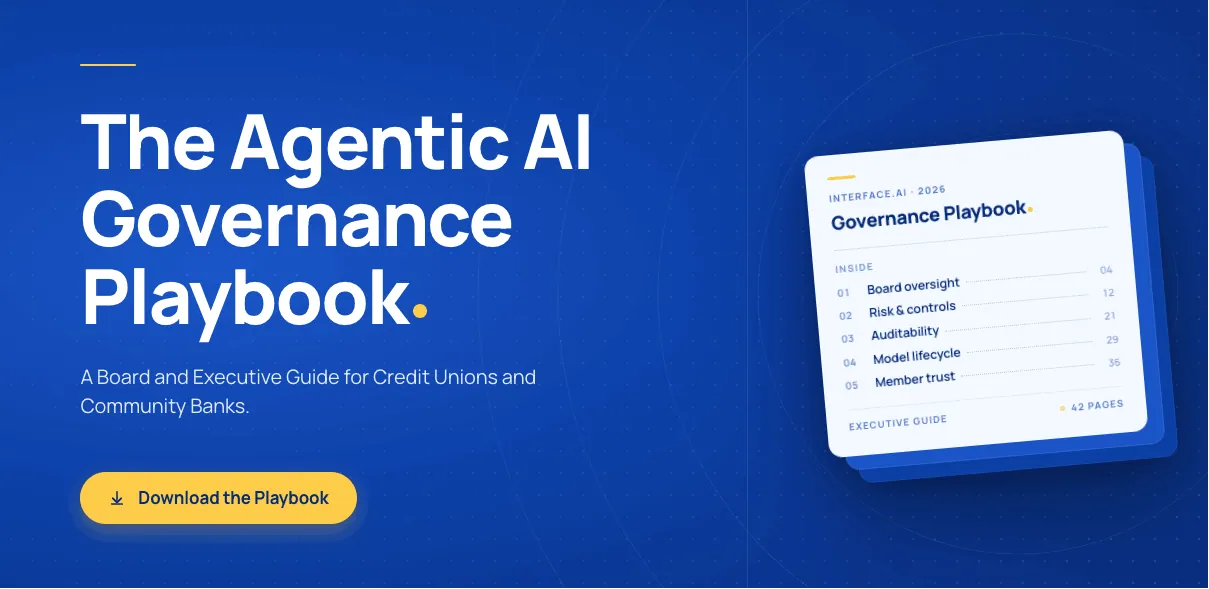
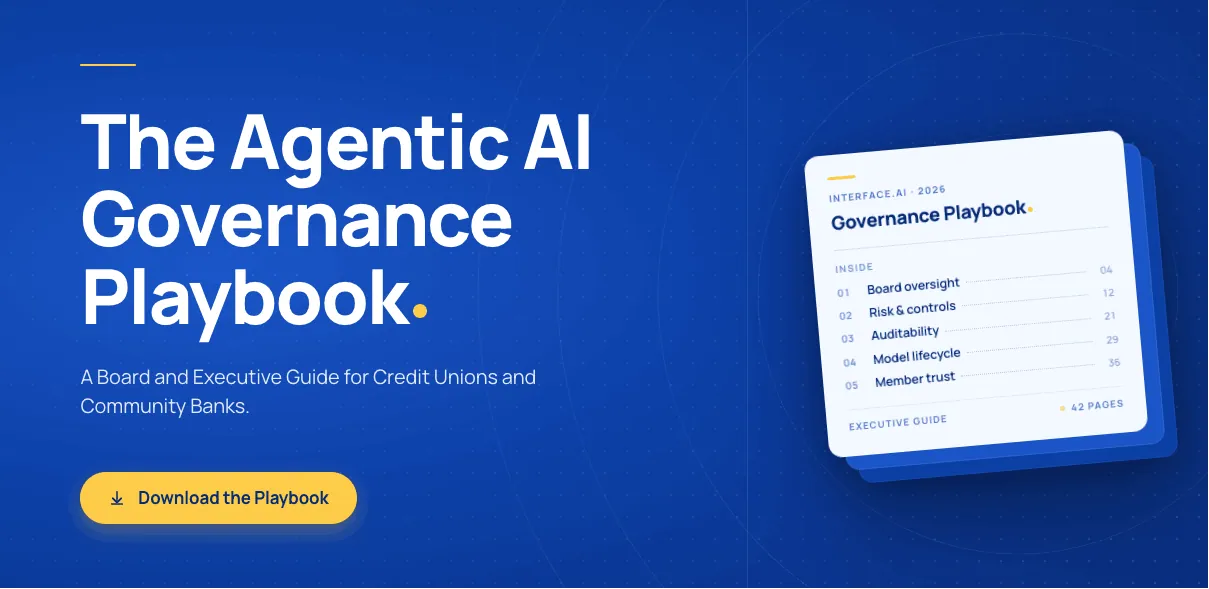
The complete playbook
We built the Agentic AI Governance Playbook for the executives and board members whose signatures sit on the minutes when an AI decision goes wrong – CEOs, CFOs, COOs, Chief Risk Officers, Chief Compliance Officers, General Counsel, and board directors.
The 46-page guide covers the full governance program: the regulatory landscape across NCUA, OCC, FDIC, CFPB, and Treasury; a five-pillar governance framework; the board risk appetite conversation; how to build your policy stack; vendor due diligence requirements; and a 180-day rollout plan. It also includes four ready-to-use templates – an AI Governance Policy, a Vendor Due Diligence Questionnaire, a Model and Use-Case Inventory, and Board Charter Language – that your general counsel can adopt with minor edits.
Kate Rogerson
AI Insights for Credit Union & Community Bank Leaders
Join the monthly newsletter for all the latest industry updates
No spam. Unsubscribe anytime.
You might also like

Agentic AI for Credit Unions and Banks – The Questions You Should be Asking
“Agentic AI” is the most-pitched phrase in banking technology right now. Every vendor claims it, few define it the same way, and the demos all look impressive. For the leaders actually signing the…
Kate Rogerson July 24, 2026Agentic AI
Members Don’t Hate Automation. They Hate Bad Automation
There’s a stat that gets used to argue members will never accept AI: 80% of consumers who use a banking chatbot walk away more frustrated than when they started. Nearly the same share…
Kate Rogerson July 16, 2026Agentic AIAI Insights for Credit Union & Community Bank Leaders
Join the monthly newsletter for all the latest industry updates
No spam. Unsubscribe anytime.