Return on Effort: The AI Metric Credit Unions Should Care About
ROI gets the headlines, but the metric that predicts long-term AI success is different. This guide introduces Return on Effort—a framework for measuring how AI reduces the total work burden on your team—and shows what a 12-week pilot looks like in practice.

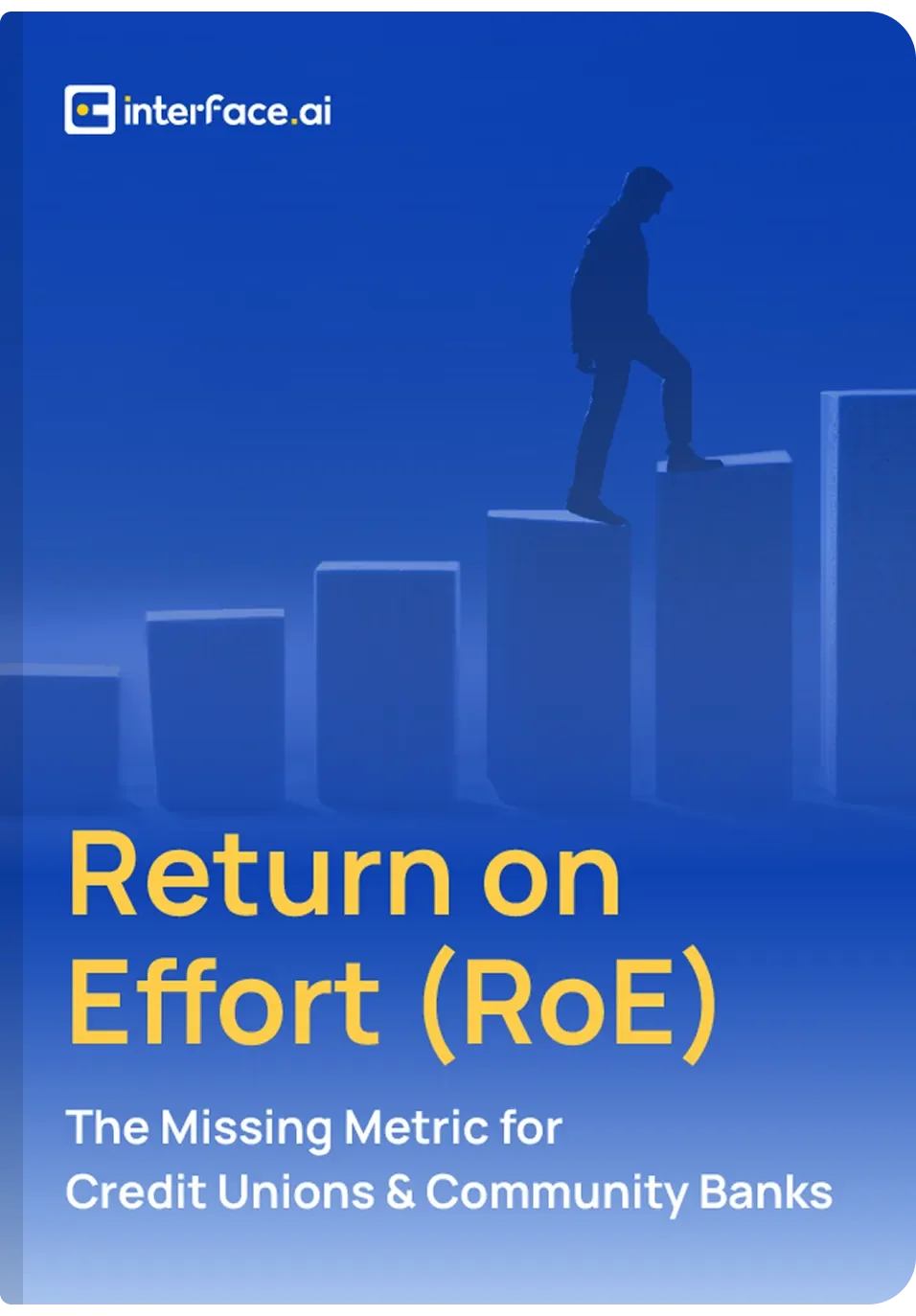
Every AI conversation eventually turns to ROI—dollar savings, cost per call, headcount reduction. Those metrics matter. But they’re lagging indicators. By the time you calculate your ROI, you’ve already decided whether the deployment worked. The metric that tells you faster—and predicts long-term adoption—is Return on Effort. How much does your staff have to do to make AI work? How much does it reduce the effort required to serve members? RoE is the metric that separates AI that sticks from AI that gets quietly abandoned after the pilot.
70%
Of inbound calls handled autonomously by Voice AI across interface.ai deployments
12 weeks
From contract to first live deployment
250%+
ROI reported by interface.ai clients within the first year
Written for boards and the people who brief them.
“We went from skeptical to fully bought-in within the first 90 days. The effort reduction on our team was immediate and measurable.”
interface.ai client $800M Credit Union
Common questions
How is Return on Effort different from ROI?
ROI measures financial return relative to investment. RoE measures how much work—for your staff and your members—is reduced or eliminated by AI. Both matter; RoE is more predictive of long-term adoption and satisfaction.
What does a 12-week pilot actually include?
Weeks 1–4: integration and configuration. Weeks 5–8: testing, conversation design, and staff training. Weeks 9–12: soft launch, performance monitoring, and optimization. You go live at the end of the pilot with a fully operational deployment.
What metrics should I track to measure RoE?
Core metrics include automation rate (% of interactions fully resolved by AI), average handle time for escalated interactions, staff survey data on workload, and member effort scores.
What's realistic to expect in the first 90 days after going live?
Most institutions see measurable automation rate gains within 30 days. By day 90, many are at 60–70%+ automation on their target use cases, with full ROI calculation available by month 4–6.
Is the pilot risk-free? What happens if it doesn't hit our targets?
interface.ai structures deployments around clear performance benchmarks. Pilots include defined success criteria, and the team works with you to hit them before recommending full expansion.
Get the full guide
More from the Knowledge Center
The Agentic AI Governance Playbook
Most credit unions and community banks are already running AI agents. Fewer than one in eight have a governance program to match. This playbook gives boards and executive teams the framework, the policy templates, and the 180-day rollout plan to close that gap — before the examiner does.
Read more
Why Agentic AI is Replacing the Collections Queue
How credit unions and community banks are using AI to recover more debt, faster - without adding headcount.
Read more
A Practical Guide to Scaling Self-Service AI in Credit Unions & Banks
A step-by-step guide to expanding AI across your contact center - from first deployment to full automation.
Read more
Top 8 Contact Center Requests Perfect for Agentic AI Automation
The highest-volume call types credit unions and community banks should automate first - and why.
Read more
What is Agentic AI? (And Why Does It Matter?)
A plain-language explainer on what agentic AI is, how it differs from basic chatbots, and what it means for banking.
Read more
The ROI of Agentic AI in the Contact Center
A breakdown of the cost savings, efficiency gains, and revenue impact AI delivers in banking contact centers.
Read more