What Is Agentic AI — And Why Credit Unions Can't Ignore It
Not all AI is built for banking. This guide breaks down what agentic AI actually is, how it differs from basic automation, and why financial institutions are deploying it to handle their most critical member and customer interactions.

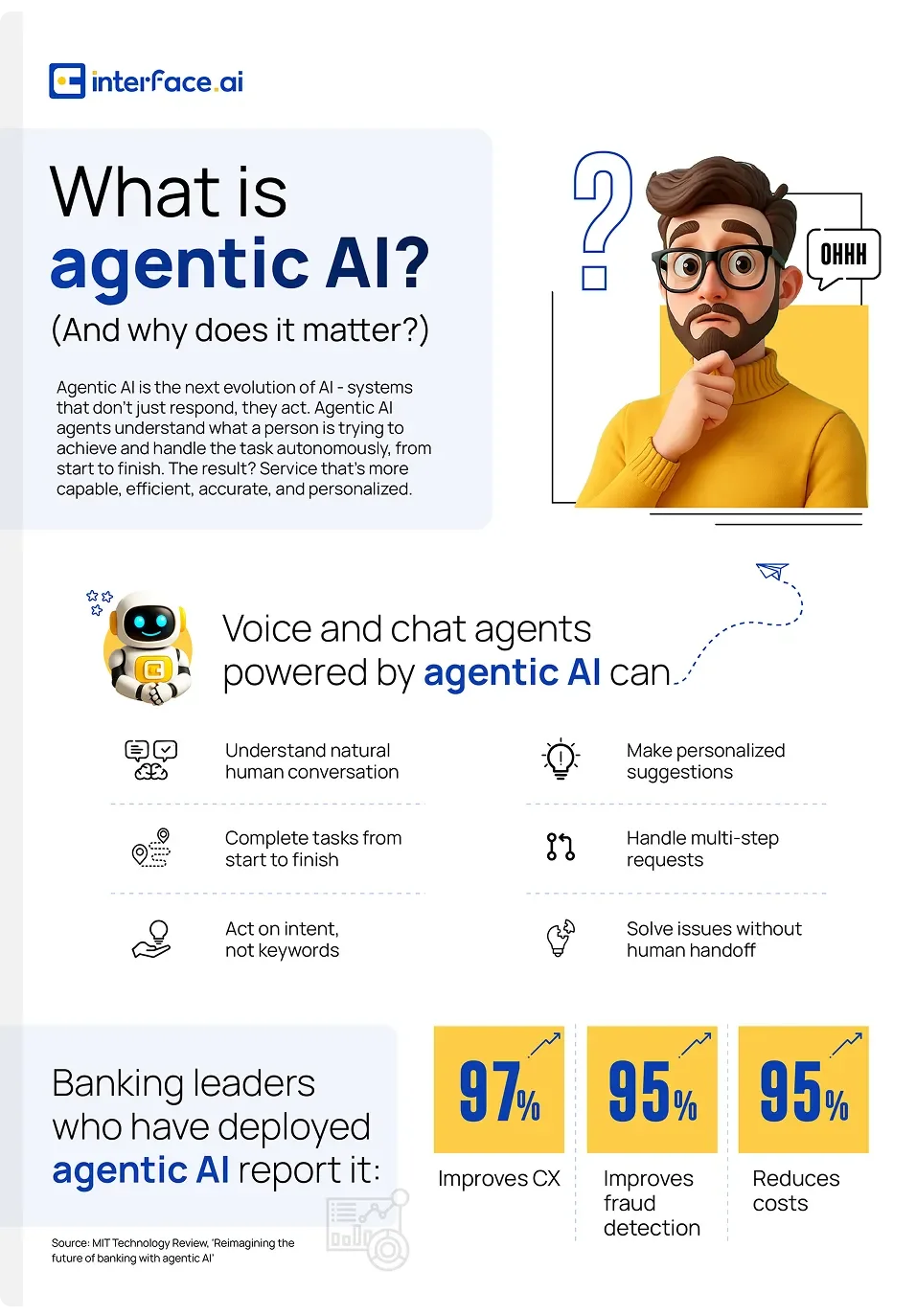
The word “AI” is everywhere—but not everything called AI can actually think, decide, and act in real time. Agentic AI is different. It doesn’t just respond to prompts; it executes tasks end-to-end with the autonomy of a trained employee. For credit unions and community banks already stretched thin on staffing and service capacity, this distinction isn’t academic. It’s the difference between another piece of software and something that genuinely changes how you operate.
97%
Member satisfaction rates reported by interface.ai clients
95%
Reduction in contact center costs achievable with agentic AI
70%
Of banks and credit unions plan to adopt AI within two years
Written for boards and the people who brief them.
“interface.ai has been a game-changer for our contact center. Member satisfaction is through the roof.”
Krystal Brown Navigator Credit Union
Common questions
What's the difference between agentic AI and a chatbot?
Chatbots follow scripted decision trees. Agentic AI understands intent, accesses live data, and resolves issues autonomously—without escalating to a human unless truly needed.
Do I need to replace my current tech stack to use agentic AI?
No. interface.ai is designed to integrate with your existing core banking system, CRM, and contact center platform—not replace them.
Is agentic AI safe for handling sensitive financial conversations?
Yes. interface.ai is built specifically for financial institutions, with bank-grade security, compliance safeguards, and audit trails built in.
How long does it take to deploy?
Most implementations go live within 12 weeks, including integration, training, and testing.
What types of interactions can agentic AI handle?
Balance inquiries, loan applications, account changes, fraud alerts, collections outreach, employee HR questions, and more—across voice, chat, and internal systems.
Get the full guide
More from the Knowledge Center
The Agentic AI Governance Playbook
Most credit unions and community banks are already running AI agents. Fewer than one in eight have a governance program to match. This playbook gives boards and executive teams the framework, the policy templates, and the 180-day rollout plan to close that gap — before the examiner does.
Read more
Why Agentic AI is Replacing the Collections Queue
How credit unions and community banks are using AI to recover more debt, faster - without adding headcount.
Read more
A Practical Guide to Scaling Self-Service AI in Credit Unions & Banks
A step-by-step guide to expanding AI across your contact center - from first deployment to full automation.
Read more
Top 8 Contact Center Requests Perfect for Agentic AI Automation
The highest-volume call types credit unions and community banks should automate first - and why.
Read more
Return on Effort (ROE): How Banking AI Delivers Outsized Value with Minimal Lift
Why the best banking AI deployments don't require heavy IT lift - and how to measure the value you're getting.
Read more
The ROI of Agentic AI in the Contact Center
A breakdown of the cost savings, efficiency gains, and revenue impact AI delivers in banking contact centers.
Read more