Smarter Contact Center Security: AI-Powered Authentication for Financial Institutions
Caller ID spoofing, social engineering, and deepfake voices are now targeting your contact center. This guide covers how AI-powered authentication—combining caller ID verification with device biometrics—closes the gaps that legacy security systems leave open.

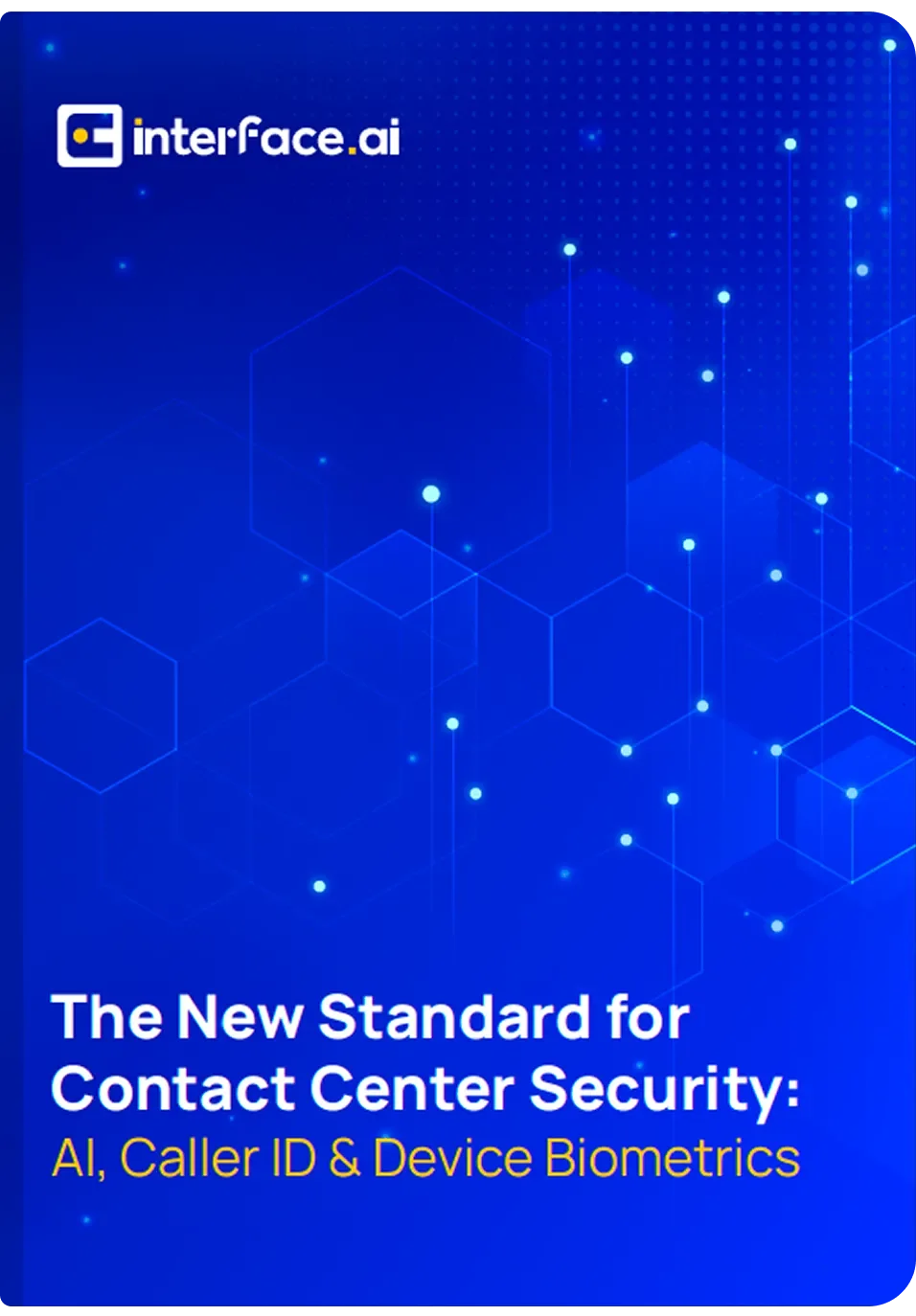
Your contact center is the most common entry point for financial fraud. Fraudsters know that security is weakest when a caller is on the line—authentication is manual, agents are under time pressure, and knowledge-based verification (date of birth, last four of SSN) has been compromised for a majority of Americans. The institutions staying ahead of this are moving away from what members know toward what their devices prove. This guide covers the technology, the threat model, and the deployment path.
$12.5B
In annual fraud losses linked to contact center vulnerabilities
60%
Year-over-year increase in voice fraud attempts targeting financial institutions
85%
Reduction in account takeover fraud with AI-powered biometric authentication
Written for boards and the people who brief them.
“We stopped asking members to prove who they are and started letting the technology do it for them. Fraud dropped, satisfaction went up.”
interface.ai client Community Bank
Common questions
What's the difference between caller ID verification and device biometrics?
Caller ID verification checks whether the call is coming from the member’s registered device and number, catching spoofed calls. Device biometrics uses behavioral and device signals to confirm identity without asking security questions.
Does AI authentication add friction to the member experience?
No—that’s the point. Authentication happens in the background before the conversation even starts. Members don’t have to answer security questions, and legitimate callers experience no delay.
What happens when a call fails authentication checks?
The AI flags the interaction for heightened scrutiny, requires additional verification, or routes it to a specialist—all without tipping off a potential fraudster that the call has been flagged.
How does this integrate with our existing call center platform?
interface.ai’s security layer integrates with major CCaaS platforms and core banking systems via API, with no requirement to replace your existing infrastructure.
What regulatory standards does AI authentication need to comply with?
interface.ai’s authentication framework is designed to meet FFIEC, NCUA, and state-level cybersecurity requirements, with full audit logging and incident response documentation.
Get the full guide
More from the Knowledge Center
The Agentic AI Governance Playbook
Most credit unions and community banks are already running AI agents. Fewer than one in eight have a governance program to match. This playbook gives boards and executive teams the framework, the policy templates, and the 180-day rollout plan to close that gap — before the examiner does.
Read more
Why Agentic AI is Replacing the Collections Queue
How credit unions and community banks are using AI to recover more debt, faster - without adding headcount.
Read more
The ROI of Agentic AI in the Contact Center
A breakdown of the cost savings, efficiency gains, and revenue impact AI delivers in banking contact centers.
Read more
A Practical Guide to Scaling Self-Service AI in Credit Unions & Banks
A step-by-step guide to expanding AI across your contact center - from first deployment to full automation.
Read more
Top 8 Contact Center Requests Perfect for Agentic AI Automation
The highest-volume call types credit unions and community banks should automate first - and why.
Read more
What is Agentic AI? (And Why Does It Matter?)
A plain-language explainer on what agentic AI is, how it differs from basic chatbots, and what it means for banking.
Read more